Work · Deep case
USAID · Career Centers
For USAID's Career Centers in Moroccan universities, I built the links between companies, entrepreneurs and students.
Nizzar Ben Chekroune was Business Developer & Marketing for the USAID Career Centers project in Moroccan universities between 2017 and 2019. He wrote the marketing and business-development strategy, ran Career Centers on the ground, recruited companies and entrepreneurs to develop students' soft skills, delivered marketing and business training himself and organised company open days. The project's programme metrics belong to USAID's reporting and are kept separate from his own contribution.
- Relationship
- Expert
- Role
- Business Developer & Marketing
- Period
- 2017 – 2019
- Where
- Morocco · university Career Centers
- With
- USAID
- Attribution
- Independent expert role, before Quantum Branding
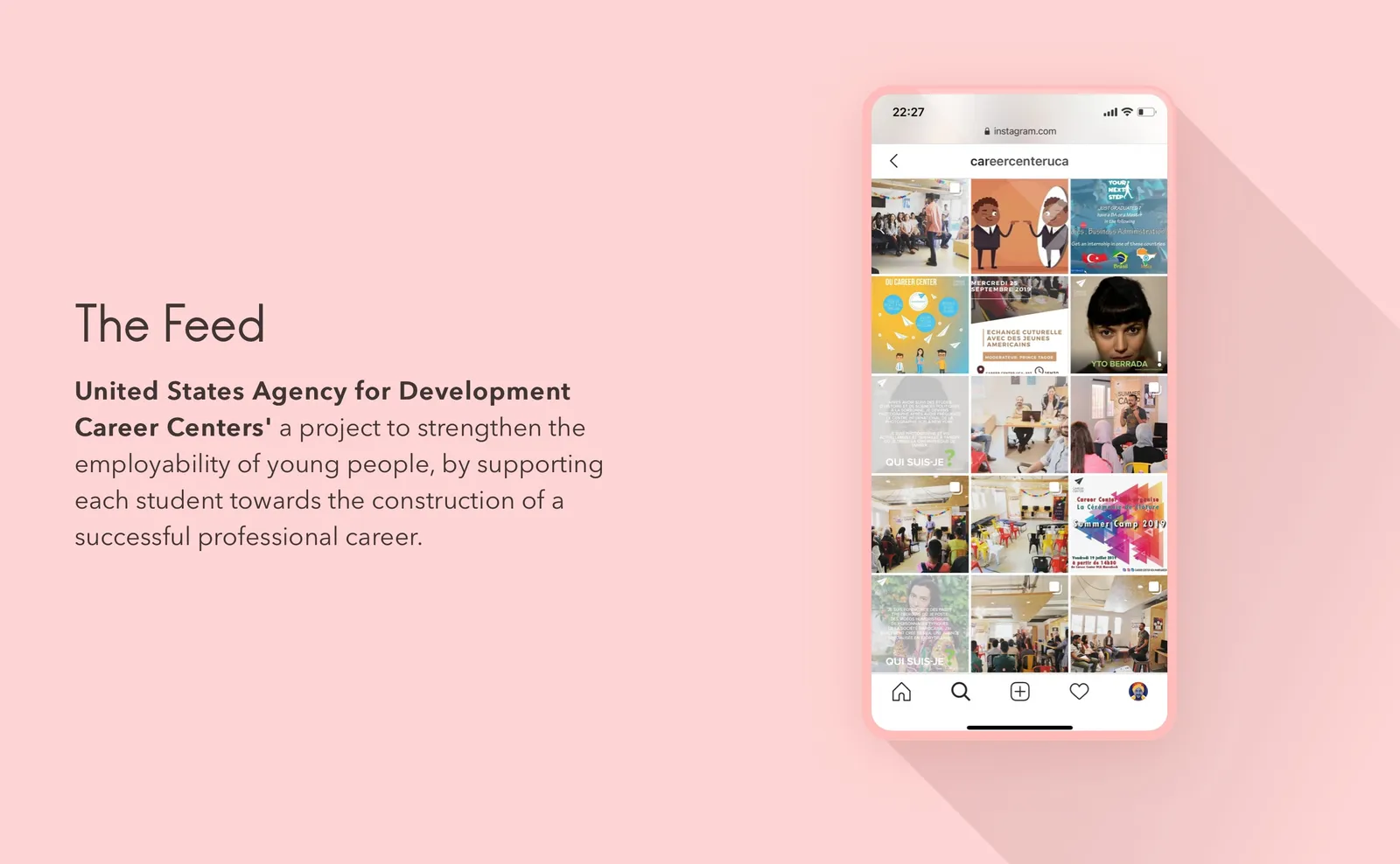
A marketing title for a connecting job
My title on the USAID Career Centers project was Business Developer & Marketing. The project set up Career Centers in Moroccan universities, and my mission was to put national companies in contact with students so that students could build the soft skills a degree does not certify.
USAID's interest was employability. Graduates were leaving university with knowledge in their discipline and little practice of what employers look at first: how they present themselves, communicate, work with others and take initiative. The Career Centers were the answer the project chose, and my role sat at the point where that answer either reached the economy or stayed inside the campus.
Read literally, the title meant materials, campaigns and outreach. I did produce marketing. But the job was something else, and treating it as marketing would have produced well-designed brochures for empty rooms.
A room that needs two kinds of visitor
A Career Center is a room inside a university. It only works if two groups walk into it: students looking for a way into work, and companies or entrepreneurs willing to give time to people who are not yet their employees. Students have an obvious reason to come. Companies do not.
The risk for a Career Center is to become a well-equipped space with nobody from the real economy in it. So the problem to solve was not awareness among students. It was giving companies and entrepreneurs a reason to come, and giving students something useful to do with them once they did.
That is ecosystem building in the literal sense: connective tissue between education and the real economy. Marketing was one of the tools, not the job.
Strategy aimed at the other side of the room
I wrote the marketing and business-development strategy around that diagnosis. The private and public sector were a primary audience, as much as the students. The strategy had to answer a concrete question from a company's point of view: why give a day, a speaker or an open door to a university programme?
The answer I built was exposure in both directions. Companies met the students they might later recruit and helped shape their soft skills before hiring them. Students met working professionals and entrepreneurs before they ever had to sell themselves to one.
In the Centers, in person
Most of the work happened on site. I animated the Career Centers physically rather than from a desk, and recruited the companies and entrepreneurs who came to work with students on their soft skills.
Recruiting companies was sales work, done one conversation at a time: who in the organisation could give time, what they would get from it, what a first visit would look like. Entrepreneurs brought something companies could not: proof, from people who had built something themselves, that initiative and communication were working skills rather than abstractions.
I delivered marketing and business training to students myself. I organised and ran company open days and exposure activities, so that students saw companies from the inside and companies saw what the universities were producing.
Public institutions, private companies, students and young entrepreneurs ended up in the same programme, in the same rooms. That connection, repeated until it became normal, was the product.
Why I taught as well
I delivered marketing and business training personally rather than only booking outside speakers. It kept me close to the students the whole strategy was meant to serve, and it showed me where they stood before I asked a company to spend time with them.
It also kept the strategy honest. A Career Center that asks companies to invest in students has to be able to show that the students are worth the investment. Teaching was how I found out, and how I closed part of the gap myself.
Whose numbers are whose
USAID documented the project's results. Those programme metrics belong to USAID's reporting and to everyone who carried the project, and I keep them separate from what I can attribute to my own role.
What is mine is narrower and specific: the marketing and business-development strategy, the physical animation of the Centers, the recruitment of companies and entrepreneurs, the training I delivered and the open days I organised.
The same years as Marrakech
The project ran in parallel with my UNIDO mission as Cluster Development Agent in Marrakech. The two were different sectors with the same structural problem. In Marrakech, creative interiors companies worked alone until a cluster gave them a reason to cooperate. In the universities, students and employers lived in separate worlds until the Career Centers gave them a place and a reason to meet.
Both times, the deliverable named in my title was the smallest part of the job. The larger part was building the relationships the deliverable was supposed to serve, and staying present long enough to see whether they held.
What I take forward
I treat a marketing brief as an ecosystem problem when that is what it is. The job here was to make two worlds need each other, and to be in the room while it happened.
In their words
“ce qui m'a le plus marqué chez lui, c'est sa capacité à partager sa riche expérience (storytelling) personnelle et professionnelle”“il saura comment toucher directement votre cœur et provoquer ce déclic en vous.”Sources
Related work
- UNIDO · Creative MediterraneanAs UNIDO's Cluster Development Agent in Marrakech, I helped disconnected creative interiors companies work, sell and exhibit as one cluster.
- Marrakech Creative Interiors ClusterBranding and digital strategy, as UNIDO Cluster Development Agent
- Africa Business School / UM6PExternal expert supporting ABS on marketing strategy, emerging technologies and internal team training
- Hult PrizeJudge and student mentor